Mismatched expectations
Mentees often don't know how to describe what they need. Mentors struggle to clearly present what they offer. So the first message rarely lands.
Case Study · 0 → 1 · Founding Designer
PM & founding designer for MentorUp — a 0→1 platform built to match mentees with the right mentors, then keep them company through the emotional gap between sessions. A community for job seekers and early-career designers when the search gets long.
Visit MentorUp ↗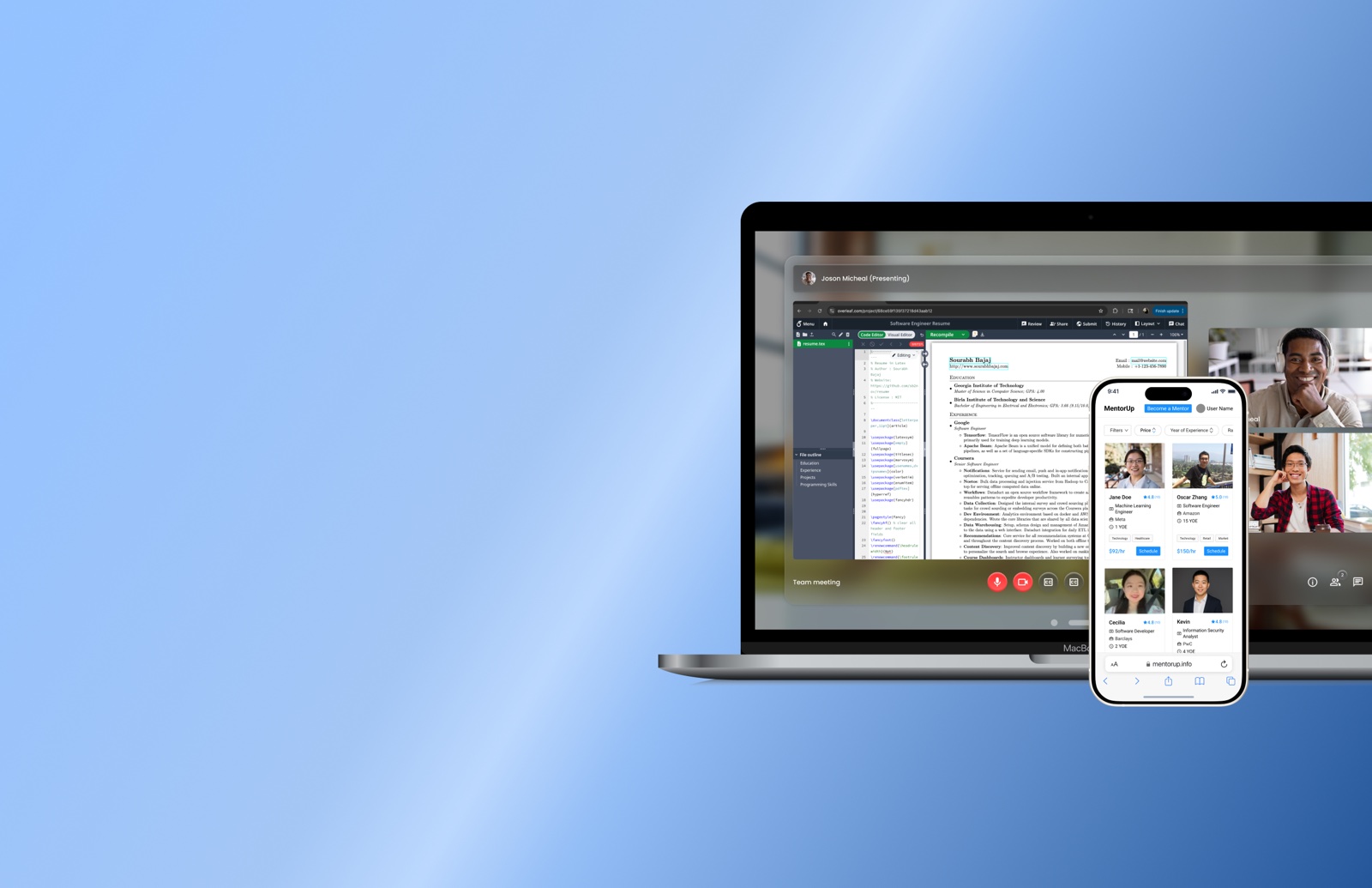
01 / The brief
When I joined MentorUp, there was nothing on the screen — only a sentence the founders kept repeating: "help early-career designers and job seekers find meaningful mentorship."
As the first and only designer, I owned everything from defining the MVP, mapping user journeys, building the design system, to shaping the 0→1 product experience. I worked closely with the founders as the bridge between business goals, user needs, and technical feasibility — setting the foundations for a product that could actually launch.
02 / Problem Space
Users can't find the right mentor — and they don't trust what they see. From early interviews, three frustrations kept showing up.
Mentees often don't know how to describe what they need. Mentors struggle to clearly present what they offer. So the first message rarely lands.
Users hesitate to book a session because the platform doesn't communicate credibility or personality. Static cards don't tell you who someone really is.
For juniors and job seekers, mentorship isn't only about knowledge — it's about encouragement, confidence, and someone "on their side" between sessions.
03 / Why this matters
"I've sent 200 applications. I've stopped opening the rejection emails. I keep wondering if the problem is me."
— interview, junior designer, 8 months job-huntingBehind every "looking for mentorship" message we read, there was a quieter sentence: I'm losing trust in myself.
For early-career STEMs, the climb is rarely linear. Portfolios get reworked at midnight. Recruiter silence stretches into weeks. Friends move on; doubts move in. Most platforms hand these people a search bar and call it a day.
MentorUp had to be more than a marketplace. It had to be a place where someone — human or AI — was always ready to say, "I see you. Here's the next small step." A community of values, not just a directory of profiles.
People don't open MentorUp to shop. They open it because they want to feel less alone in the process.
One great session doesn't fix burnout. The product had to live in the spaces between sessions.
Confidence is the real deliverable. Every flow had to leave the user a little more sure of themselves.
04 / Problem Statement
05 / MVP Flow
After defining the problem space, I translated the insights into a focused MVP — a clear, end-to-end path from "I need help" to "we just had a session" — designed so people felt held, not sorted, at every step.
Filter by domain, stage, and tone. Profiles surface personality first, credentials second — so the human shows up before the resume does.
The platform helps mentees translate vague struggles ("I feel stuck") into a clear ask — so the first message lands and the session starts in the right place.
Every mentor profile shows real session reflections, response style, and what they actually focus on. Trust is earned in scrollable detail, not stars.
One-flow booking + a post-session reflection prompt that's fed back into the next match. Each session leaves a fingerprint on the next one.
06 / Supporting flows
As the first designer, I quickly realized the four-step main journey only worked because of dozens of supporting flows behind it. Below: the structural wireframes where each flow was worked out before any visual polish.
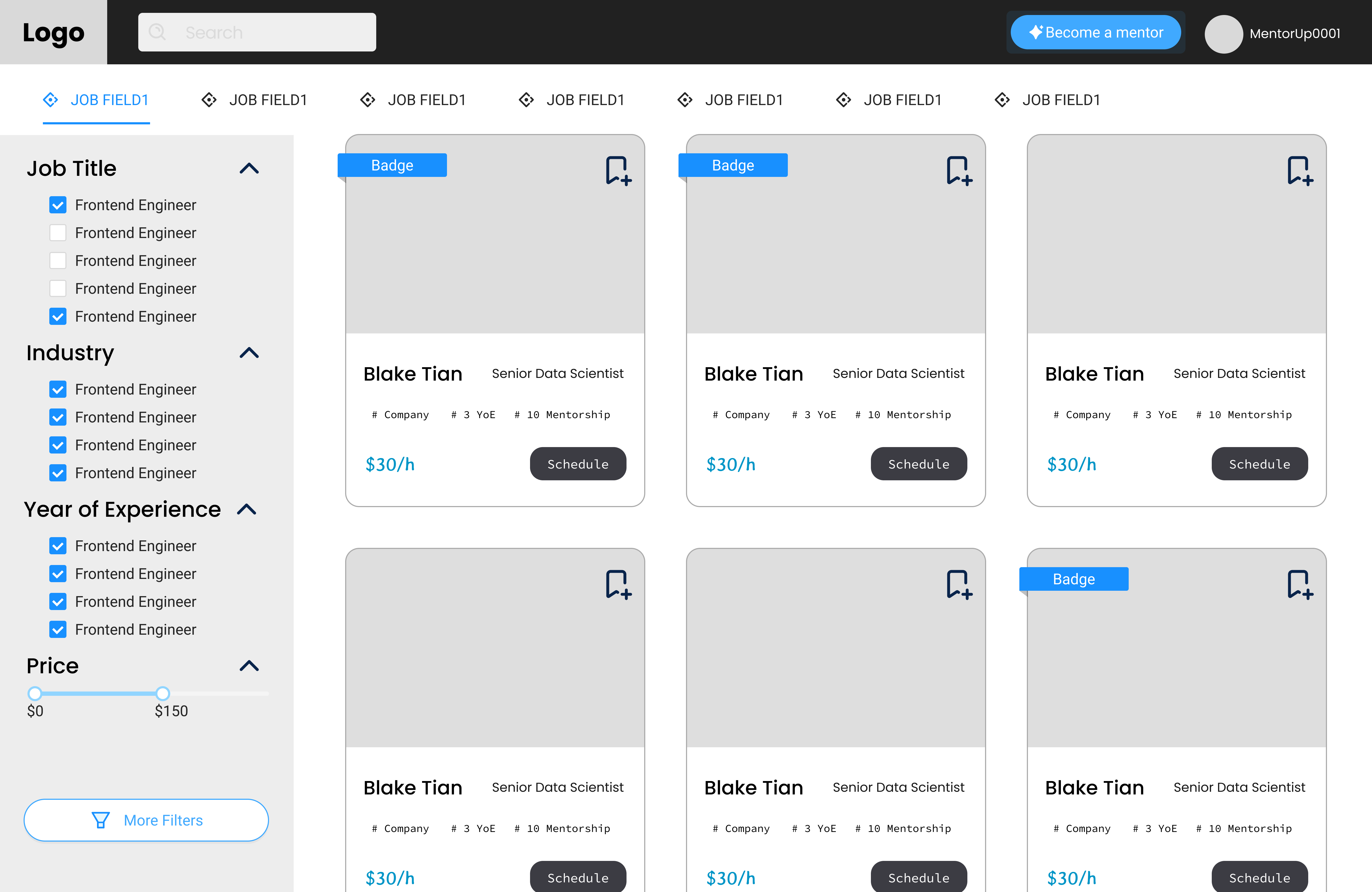
Combinable filters, price range, and a card grid tuned for comparison before commitment.
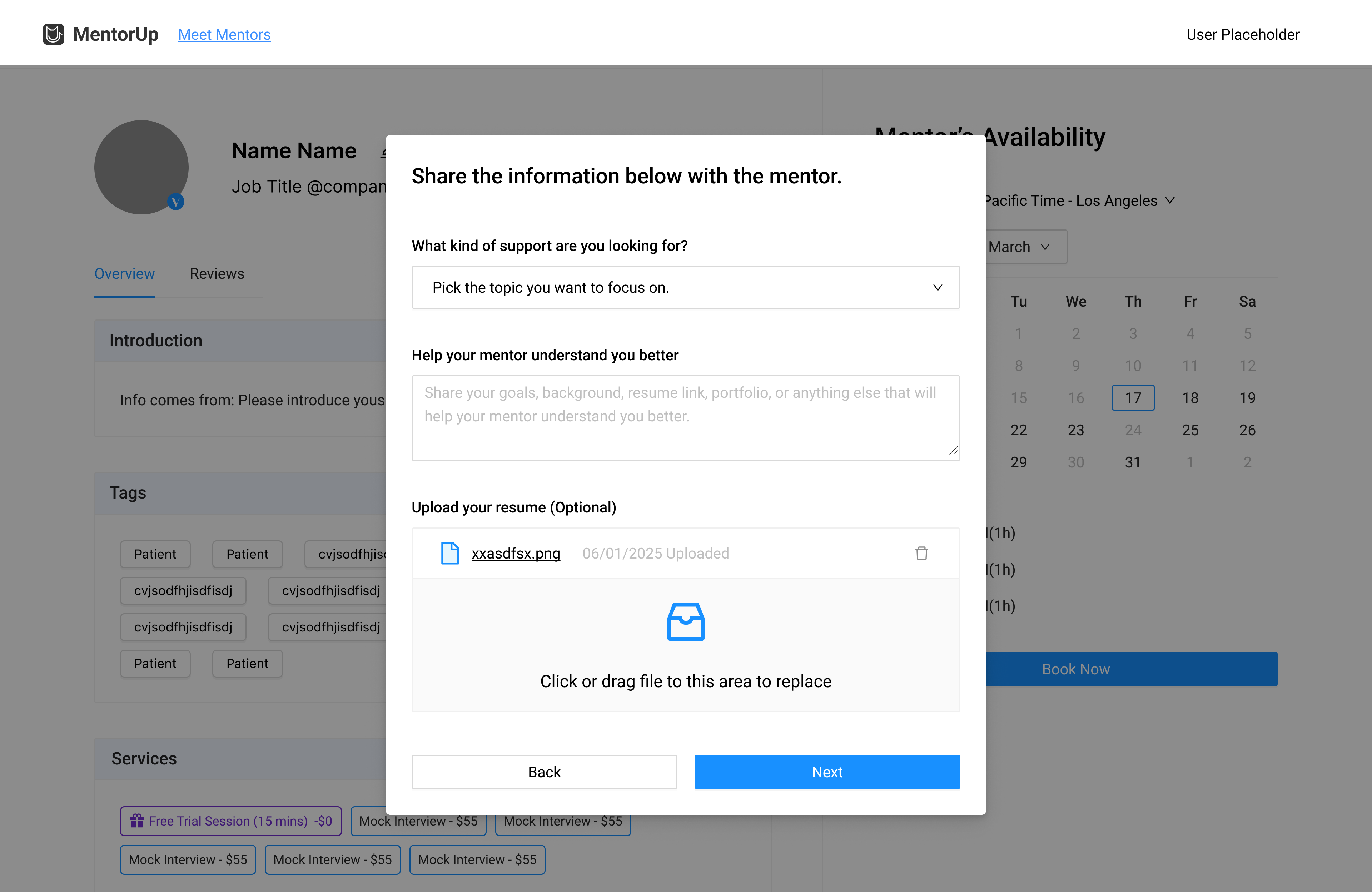
Before payment, the mentee frames their ask — topic, context, optional resume — so the session starts prepared, not cold.
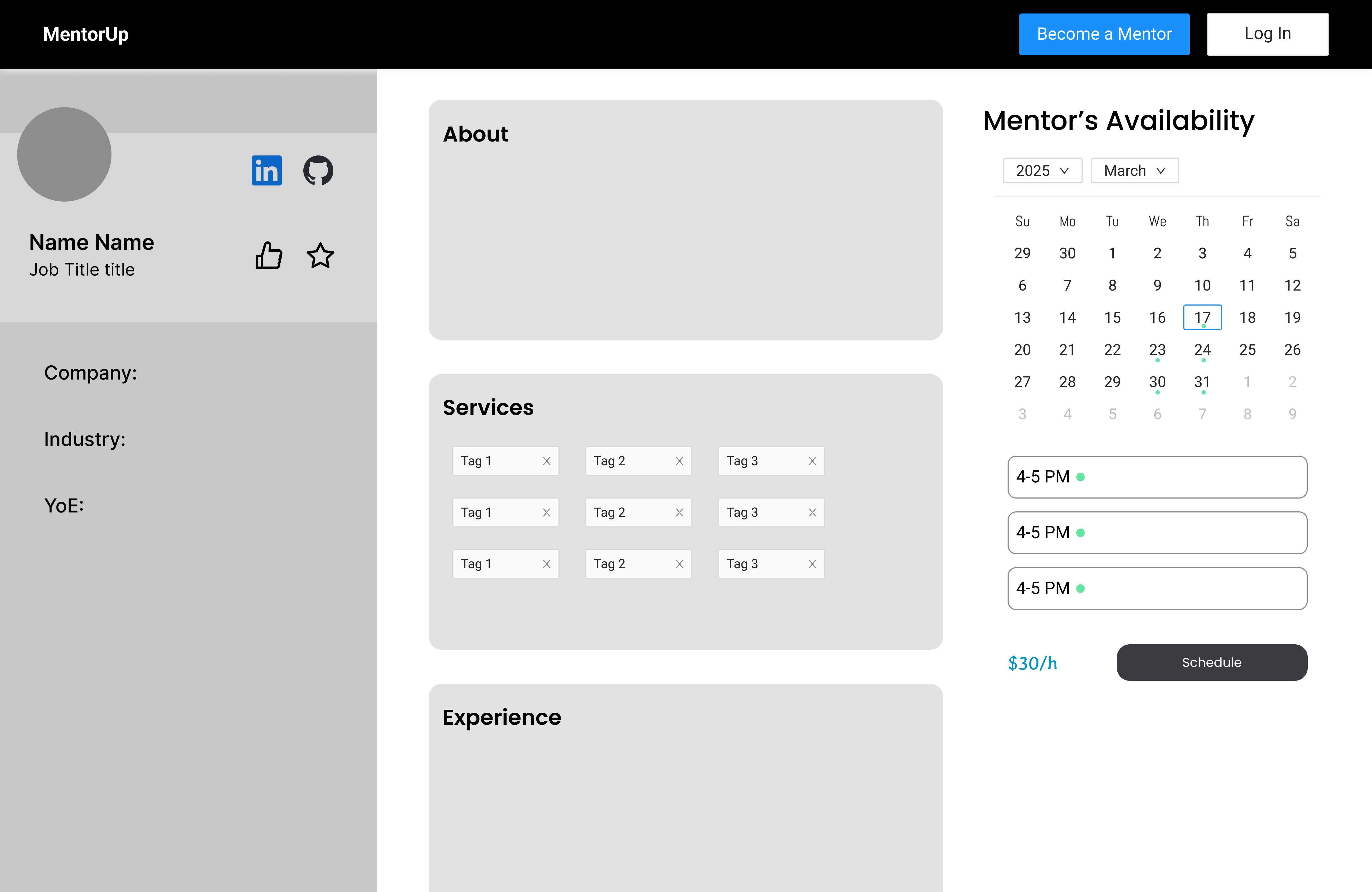
Services, tags, and a calendar that turns "when are you free?" into one tap.
Lightweight notes, follow-up nudges, and a feedback loop that fed the next match — so progress kept compounding.
07 / Product logic
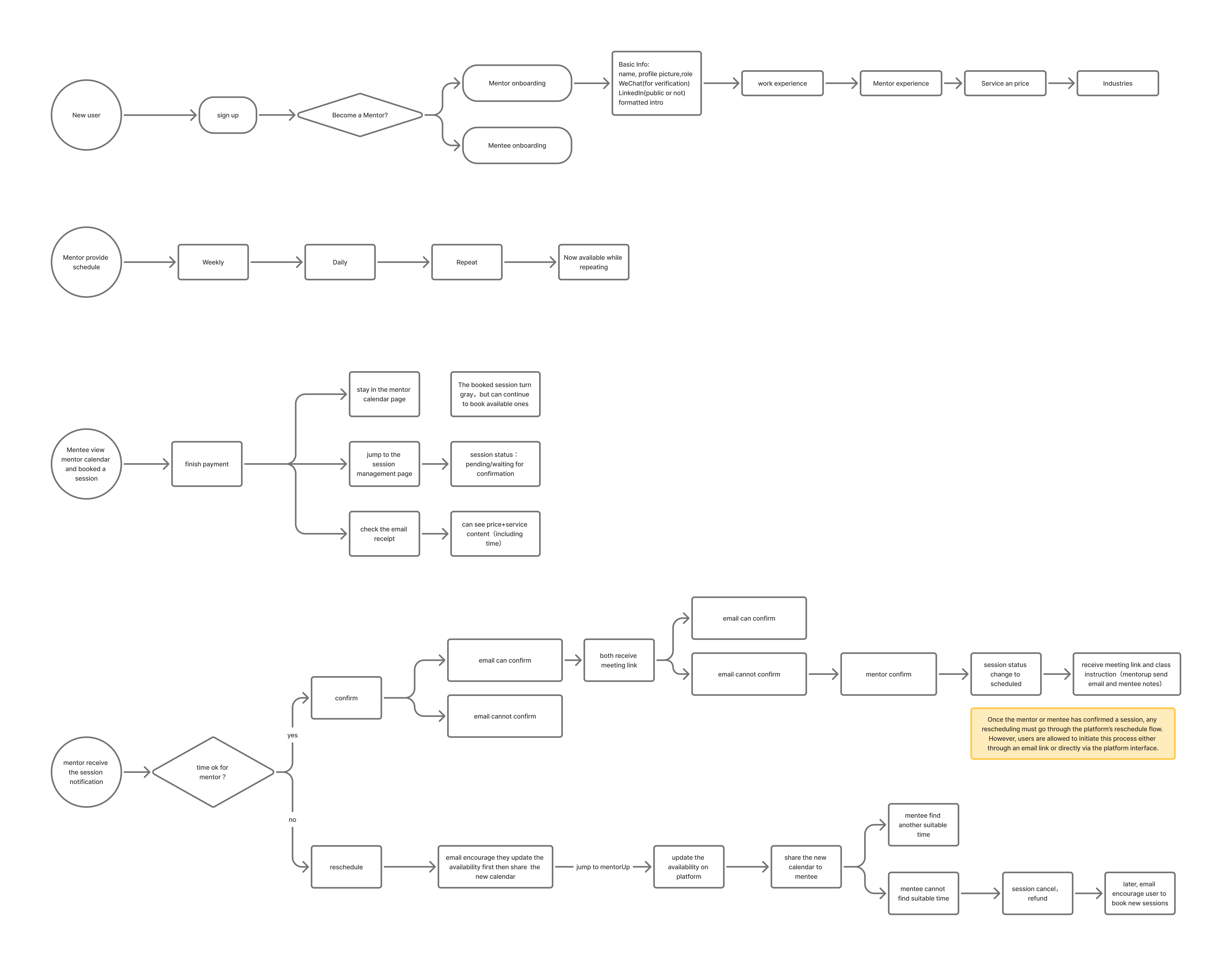
With the core journey defined, I mapped the complete product logic end-to-end — both roles' onboarding, scheduling, booking, payment, confirmation, and the reschedule and refund paths where products usually leak trust. Every screen that followed inherited its decisions from this map, alongside a lightweight token-and-component kit that kept the visuals consistent.
08 / Dual user experiences
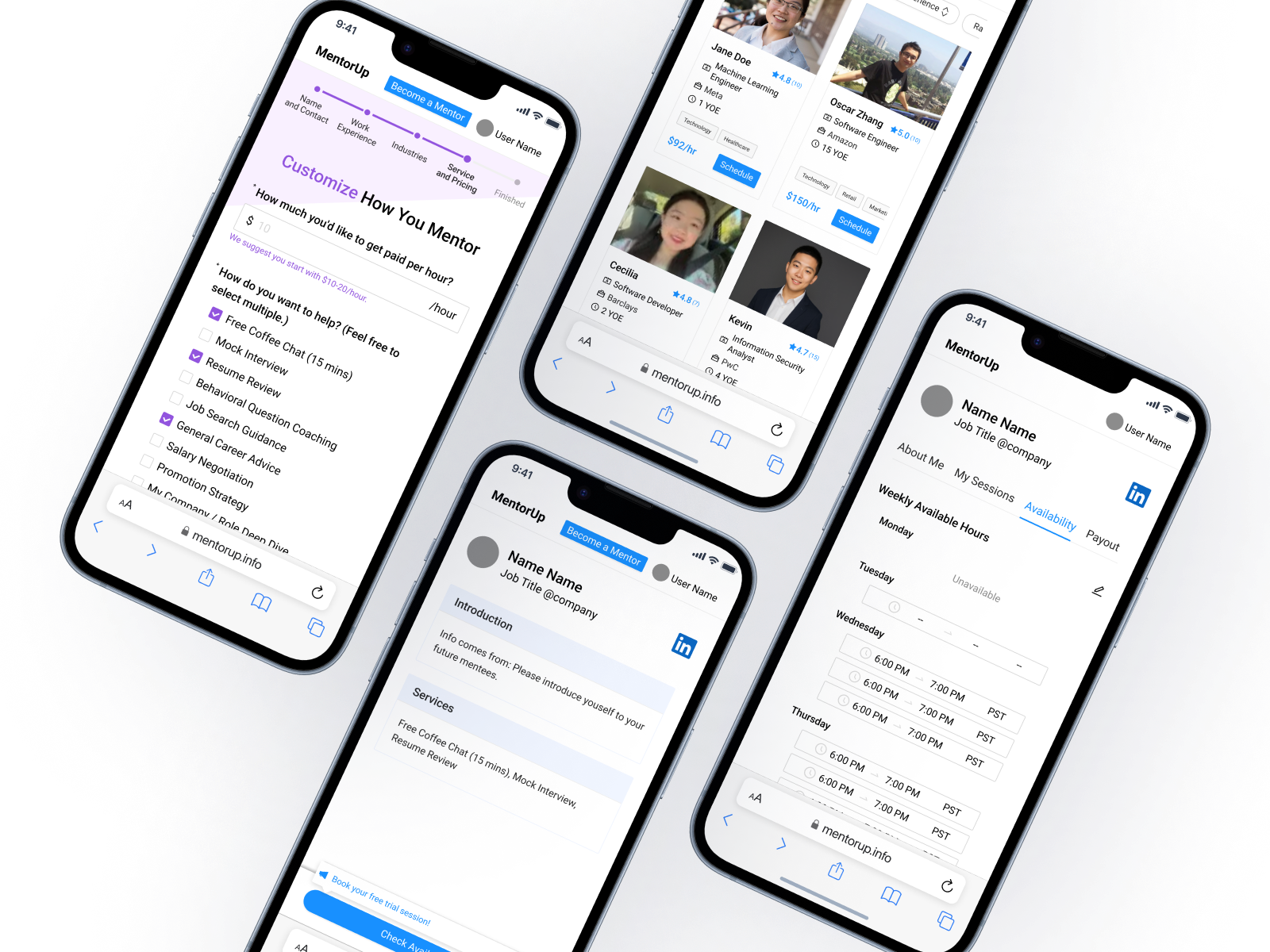
After defining the system, the next step was applying it consistently across the product — for both mentees and mentors, whose needs are wildly different. Easy to spot by one tiny CTA: "Become a Mentor."
09 / Post-launch insights
10 / Responsive mobile design
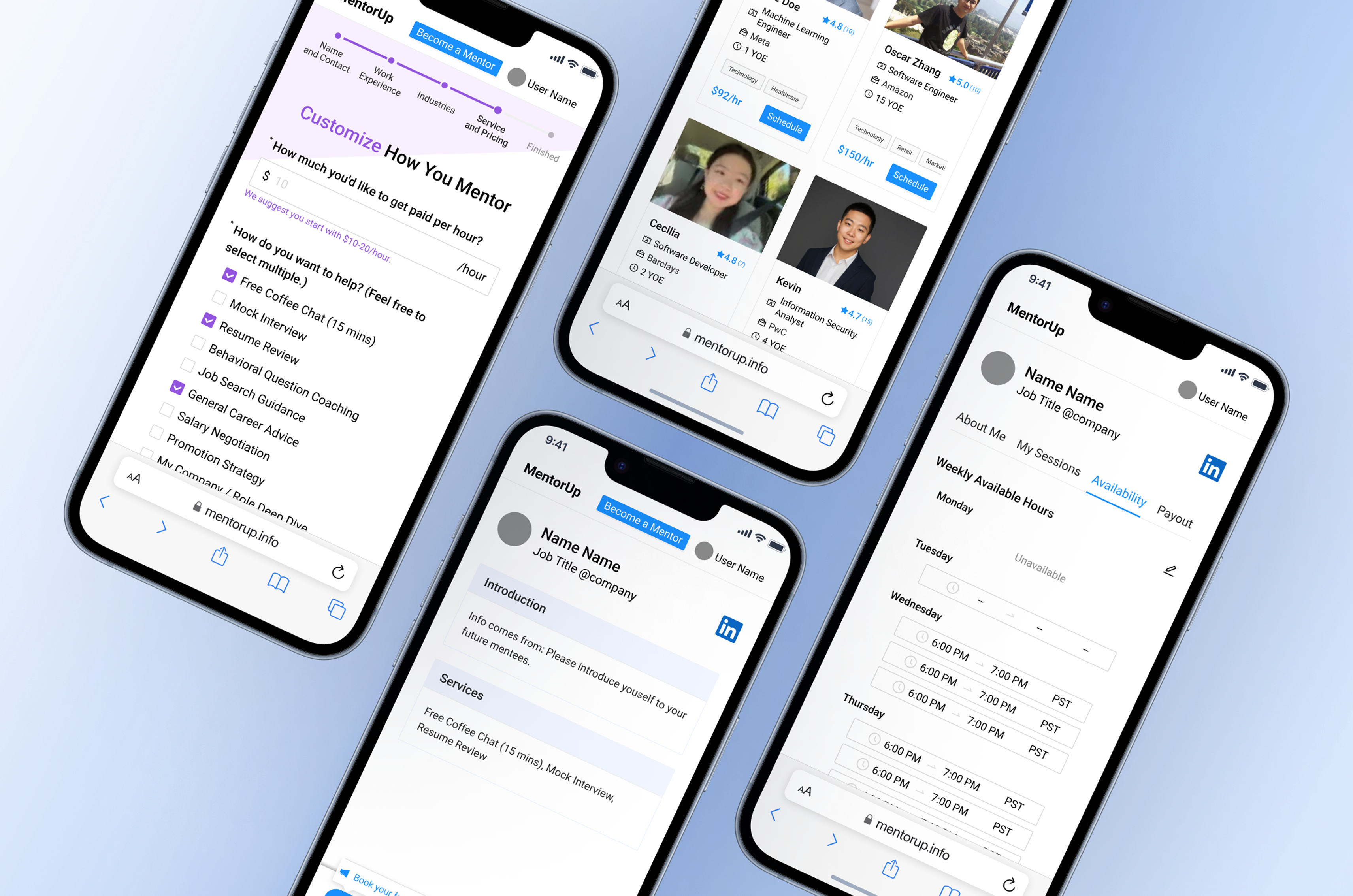
When 68% of users walked in through a phone, "responsive" stopped being a polish task. Every flow we'd designed for desktop had to feel native on mobile — not shrunk, not stacked, but reconsidered for thumbs and small moments.
11 / Emotional context
Between job applications, late-night doubts, interview rejections, and moments of deep uncertainty, many mentees felt alone. Human mentors were incredibly helpful — but they couldn't be there 24/7. And that emotional gap between sessions was where anxiety grew the fastest.
So we reimagined what "mentorship" could mean. Instead of building just a smarter FAQ, we built something more human — a layer that could hold space at 1 a.m. when no human was awake to.
12 / The AI mentorship layer
Each surface meets the user where the doubt actually shows up — before, during, between, and after sessions.
Instant answers to the everyday questions — pricing, scheduling, how to prep for a first session — so humans aren't blocked at the door.
The 24/7 companion. Listens, reframes, suggests one small next step. Tone adapts to whether the user is anxious, exhausted, or hopeful.
Resume read-throughs, interview rehearsal, portfolio gut-checks — practical strategy work that doesn't always need a paid session.
Surfaces help at the exact moment of friction — drafting an outreach DM, untangling a feedback note — without making the user ask.
Watches for hesitation patterns (re-reading a profile three times, abandoning the booking flow) and offers a gentle nudge — not a popup.
13 / AI personalization · in action
Every user comes with a different story, so the AI adapts to theirs. A junior doubting their abilities, a new grad in interview cycles, a long-term seeker fighting burnout — each gets a different tone, a different style of encouragement, a different next step. Click a persona — the AI mentor rewrites itself.
Concept prototype · how the AI mentor's persona-aware tone-shift was designed to work.
14 / Results
MentorUp successfully launched, validating both the core mentorship flow and the extended AI-supported experience. Within the early launch phase, the product onboarded 500+ early-stage users — confirming a real demand for accessible, guidance-driven mentorship.
Built from nothing
Early-stage users onboarded
AI surfaces designed into the MVP
15 / Reflections
I shaped the product logic, the design system, and the experience strategy from the ground up. The biggest lesson wasn't about pixels — it was about learning how to make thoughtful tradeoffs, moving fast without sacrificing empathy.
Next: deeper personalization and long-term support — turning the platform from a place you visit into a community you belong to.